

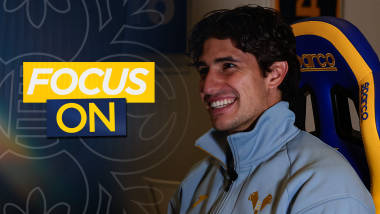
Focus On | Edoardo Iannoni
Verona - From the shyness of his early years to the determination that defines him on the pitch, Edoardo Iannoni looks back on the experiences that have shaped his growth, both on and off the field. His journey from amateur football to the professional game, the dream of playing in Serie A fulfilled with Sassuolo and his decision to join Verona, where he is now embarking on a new chapter in his career. His passions away from football, including golf, classical studies and everyday life in the Gialloblù city, complete the portrait of the midfielder in the latest episode of Focus On.
This episode of Focus On is also available on Hellas Verona’s Spotify channel.
You were born in Rome and started playing football as a child, first at Urbetevere and then in Roma's Youth Academy. What were you like as a child? What was your relationship with football and who used to take you to training? “I started playing at Urbetevere a little later than most children, when I was eight. I was very shy and quite small physically. I developed later than others, so I was always the smallest among my peers. However, I absolutely loved football. I played at every party, whenever I went out into the street and whenever I saw a ball, even if I was simply out for a walk. It was what I enjoyed most. Ever since I started playing, I don't think I've ever missed a training session. My whole family has always been by my side: my father, my mother and my brother, who still follow me both at home and away. My father, in particular, used to take me to training sessions and matches, but as a great football enthusiast, he always did so with enormous pleasure.”
As a child, did you have a particular player you looked up to and enjoyed watching? “Having been born and raised in Rome, and being a Roma fan, like many children from my city, I had Totti and De Rossi as my idols. More generally, though, when watching football, I looked up to the great champions I was lucky enough to see. I grew up in the era of Cristiano Ronaldo and Messi, the two greatest players of all time. Like all the children of my generation, I adored them and I still admire them both.”
After your time in the youth academies of Roma and Savio, you didn't follow the usual path through the Primavera teams of professional clubs, but instead moved to Trastevere in Serie D. How much did that experience shape you, including from a personal perspective, as you entered senior football without going through the Primavera? “It was a different path from the one followed by most players, because especially in recent years, many make the step up directly from youth academies and Primavera teams. I never played at Primavera level and made it into professional football through the amateur leagues. I think that experience shaped me enormously, above all because from the very beginning I had to adapt to dressing rooms full of people much older than me. In Serie D, I played alongside lads who made a living from football, who had families to support and often had other jobs as well. It's a completely different world, one that helped shape my character and also influenced the way I play, especially in those moments when matches become more physical and scrappy. That experience gave me a particular kind of grit, whereas the professional game mainly provides quality and technical foundations.”
Throughout your career, you've worked with many coaches. Is there anyone who has left a particularly strong impression on you, both as a player and as a person? “I think everyone I've met along the way has given me a lot, each in their own way. If I had to mention one name, though, I always say Fabrizio Castori. He was a very important coach for me. He was the first to give me my chance in Serie B and brought me back to Perugia when he became the team's coach. I learned a great deal from him, both on and off the pitch.”
And among the many teammates you've shared these experiences with, is there anyone you've remained particularly close to? “I'm actually still in touch with lots of my former teammates. The lads from Trastevere, my first team, and I still have a WhatsApp group and keep in touch quite regularly. I've also stayed in contact with many players from my more recent experiences. The one I've probably shared the most with is Lorenzo Masetti, back when we were at Ancona. We lived together for a year, sharing the same apartment, and we still keep in touch very often.”
Your time at Sassuolo brought you the Serie B title, promotion to Serie A and the opportunity to experience the top flight for the first time. What did reaching the highest level of Italian football mean to you, having started out in Serie D? “My time at Sassuolo meant an enormous amount to me. It was the fulfilment of a dream, the dream every child who starts playing football has: reaching Serie A. Joining Sassuolo was a great source of pride for me. I remember being incredibly happy when I signed. I was coming from Serie C and joining a club that, at the time, was in Serie B for a brief spell after spending so many years in Serie A. It's an extraordinary club in every respect and I had a wonderful time there. Those were two fantastic years. In the first, we won the Serie B title in dominant fashion, while in the second I made my Serie A debut and scored my first goal in the top flight. I'll always look back on those years with great pleasure.”
Your journey has now brought you to Verona. How are you settling in? “I've arrived in Verona and I'm absolutely delighted to have made it here. I pushed hard, together with my agent, to come here. I'm really enjoying the city, it's beautiful, and I've also settled in well with the fans, who are incredibly passionate. I think that's exactly the extra motivation I was looking for and something this club and its supporters can give you. When Curva Sud gets behind us, it really becomes the twelfth man on the pitch and, when we attack towards the stand, everything almost seems easier.”
You scored your first Serie B goal on your debut in the Gialloblù shirt, against Arezzo. How much did such a positive start help you? And how have you settled into the group, considering you were one of the last players to arrive? “Making a strong start is always very helpful because it gives you an immediate confidence boost and the mental drive to keep performing well. It was certainly very important. I settled into the group straight away. The lads are all very welcoming and I get on really well with every one of them. We also live quite close to one another, as many of us have homes in Verona city centre. This means we can see each other often and spend time together off the pitch too, which helps bring the group together.”
After a difficult start, you've gone on to record five consecutive positive results, with the last three matches ending in clean sheets. What do these numbers tell you? “It's been a slightly difficult start to the season. We certainly expected to get off to a different start and things didn't go as well as we had hoped, but the last few matches show that we're getting back on track. We're pleased with the way we've reacted to a start that was below expectations, although these things can happen, especially in a league like this and for a team coming down from Serie A. It's a situation I've already experienced at Sassuolo. Serie B is a long campaign, though, and the table always remains very tight. We're right in the mix and the important thing is to stay close to the teams around us. I believe that, given this team's potential, we'll be able to make the difference as the season progresses.”
Do you think the 16 points you've collected so far reflect your performances on the pitch, or do you feel you deserved more? “I think we could easily have picked up a few more points. Of course, though, you can't really look at football that way. The ball is round and some matches that we perhaps deserved to win, including the one against Mantova, ended differently from how we would have liked. We have to accept the results, but from now on we need to do much better.”
Hellas have a midfield with plenty of options, featuring players with quite different characteristics. How do you complement one another? “I think midfield is a very strong department. We have players with different characteristics, but they're all good, and the coach knows how to use us and manage the rotations. Competition is absolutely not a problem. On the contrary, I think it's an added value. When there's competition, especially healthy competition like the kind we have, the whole team can only improve.”
You've already scored two goals this season. Have you become more confident in making forward runs, or is it also down to what the coach asks of you? “I think it's mainly a matter of confidence and consistency, including in terms of playing time. The coach has shown a lot of faith in me and I've had plenty of opportunities in the opening matches. I think that really makes a difference. One of my strengths is also my ability to score goals. I'm certainly not a prolific goalscorer, but I believe I can achieve good numbers for a midfielder, especially if I can play regularly and with confidence.”
You're a midfielder who combines running power and physicality, capable of joining attacking moves while also contributing defensively. Which of your qualities best represents you, and what would you still like to improve? “I believe my main strengths are my running ability, acceleration and driving forward with the ball. At the same time, I know there are still several areas I need to work on. The one I'd most like to improve is my final pass, my ability to create chances in the final 20 or 30 metres of the pitch.”
You've been part of many dressing rooms from a very young age. What kind of teammate are you? Have you already developed any particularly close relationships within the Verona dressing room? “I'm generally quite reserved. Whenever I join a new environment or a dressing room I don't know, I always take a step back at first. Here too, as I was the last one to arrive, I behaved in the way I usually do. Once I settle in and open up to the people I share the dressing room with, though, I can become quite talkative. I enjoy joking around, going out and spending time with the team, which is something we do quite often. Overall, I've found a really great group and I've got on extremely well with everyone. I already knew Samuele Mulattieri and, from the moment I arrived, I've also built a good relationship with Zappa, Lella and Perilli. I share the journey to training with the latter two because we live close to one another in Verona. That has allowed us to build an even closer bond and friendship.”
You've chosen to wear the No. 44 shirt. Is there a particular meaning behind that choice? “Not really, there's no particular meaning. I've always liked the number 4, also because of the position I play. I wore it at Perugia, while at Sassuolo I couldn't have it because the number 4 had been retired in honour of Magnanelli. I would have liked to choose No. 4 here too, but Zappa arrived a few days before me and beat me to it! So I settled for 44.”
You've played in many different cities. Do you enjoy exploring the places you live in? In Verona, beyond the best-known attractions, have you found any particular spots you especially like? “It really depends on the city I'm in. Verona is definitely a city I enjoy living in because it's beautiful and full of life. That's exactly why I chose to get a place in the city centre. I really like the city and Piazza delle Erbe is probably the place that impressed me most from the very beginning, especially because of its beauty. I also enjoy simply walking around Verona and exploring its quieter, less crowded side streets, which are lovely to see and experience. It's a lively city, sometimes even chaotic. You might be walking along Via Mazzini, where there are so many people and lots of noise, then take just a few steps away, turn into a quieter side street and suddenly you can't hear a thing. It's quite an interesting characteristic.”
How different is the Edoardo we see during matches from the person people get to know in everyday life? “Off the pitch, I'm quite reserved and a very good-natured person. During matches, though, you see a much more determined player. As I said before, when I enter a new environment, I always tend to take a step back at first and I'm not a particularly outgoing person. On the pitch, however, things change quite a bit. I also like to get stuck in and, when a strong challenge is needed, I don't hold back. In that respect, I'm definitely different.”
You attended a classical high school, an educational path that isn't particularly common among professional footballers. Were you always able to balance your studies with your sporting commitments? Is there a subject you'd like to explore further in the future? “I've always managed to balance football and studying. I've always been good at organising my time and I also achieved good results at school. Classical high school taught me a great deal and allowed me to meet some important people. I chose it because I've always enjoyed the subjects that are part of this curriculum, especially the humanities. If I had to choose one to explore further, it would definitely be history.”
How do you like to spend a day off when you don't have training? “Since I have a place in the centre of Verona, until last week, when the weather was still nice, we made the most of the days by going out, spending time together and going for walks. Generally, it depends on what comes up. I also enjoy playing golf, so whenever I get the chance, I like to go and hit a few shots.”
Speaking of golf, one of your passions: it's a sport that requires concentration, precision and patience. Where did this interest come from, and do you think it also helps you in football, especially from a mental perspective? “I started playing around two or three years ago, when I joined Sassuolo. I actually lived inside a golf club, so that's how I first got into the sport. I enjoyed it straight away and became passionate about it, also because I used to play with some of my teammates. It's a very relaxing sport, but it also requires a lot of concentration and, above all, patience. At times it can be frustrating, so you have to learn how to approach it in the right way, especially when you're starting out. I think it's something that's useful in everyday life too, because it teaches you how to deal with certain situations.”
Beyond results, points and goals, what would you like to take away from your experience in Verona? “Regardless of all the objectives, I'd certainly like this experience to help me grow as a person in many different ways, both technically and tactically and in terms of character. I'd like to become more and more of a leader and an important player for the team, including off the pitch.”