

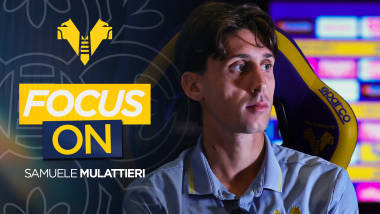
Focus On | Samuele Mulattieri
Verona – In the latest installment of Focus On, we get up close and personal with Samuele Mulattieri. His journey started at Spezia, took him through Inter Milan and the Netherlands, and continued across Italy and Spain before finally landing him in the Gialloblù colors. Speaking to our microphones, Samuele reflects on the key milestones of his development: from his first goals in a Hellas shirt to the family legacy tying him to Arcola Garibaldina, right through to his passion for playing the piano.
This episode of Focus On is also available on Hellas Verona’s Spotify channel.
Samuele, let’s start with Verona. What convinced you to embrace this new challenge and choose Hellas? "I chose Verona because it's a massive club with an incredible fan base. I'm really glad I made this decision; when I arrived, I found a fantastic group of lads. I hope we can achieve a lot of great things together."
You joined this summer following a spell in Spain with Deportivo. What were you looking for in this new chapter, and what did you find here in Verona? "I was looking for a team where I could showcase my qualities and help push toward an important objective. Daily hard work is going to be the deciding factor that gets us where we want to be."
You’ve already bagged three goals in this shirt, including the decisive winner in Cagliari that secured Verona's progression in the Coppa Italia and earned you the Man of the Match award. How much confidence have these opening goals given you? "Scoring is always vital, it feels amazing and gives you a massive confidence boost. The key is never letting up and keeping performance levels high. What matters most is delivering on the pitch and ensuring the squad hits its targets."
What was your first impression of the Bentegodi and the Gialloblù supporters, especially after experiencing the rush of a derby victory? "The Bentegodi is an unbelievable stadium, and the fans are truly magnificent. It's a joy to play there, and the feeling after winning against both Arezzo and Vicenza in the derby was simply wonderful. We always have to keep pushing to give these supporters what they deserve."
Let’s wind the clock back and retrace some of the steps that brought you here. Your journey began close to home at Spezia. What memories do you have of that young Samuele first dreaming of turning professional? "Up until I was 16 or 17, I didn't look at it as a job; I was just playing for fun. Then I had a strong year in the Primavera, made my first-team debut, and realized football could become much more than just a passion. Spezia is the city where I grew up. Those were fantastic years where I matured both as a man and as a player, so I cherish those memories."
Then came Inter. What did it mean to you, as a young player, to enter such a prestigious youth academy and measure yourself against coaches and players of that caliber? "I spent two seasons with Inter's Primavera, which was another brilliant experience. I had opportunities to train with the first team and learn from top-tier footballers. I was very young, so it was a formative chapter that provided me with lessons I still carry with me today."
Among the players in that Primavera side was Gabriele Zappa, whom you've now reunited with here in Verona. When you saw each other again, what was it like looking back on those years and seeing how far you’ve both come? How would you describe your relationship? "We shared a season together in the Primavera, and it was a great time. We got along really well; he's a top lad and a fantastic player. It was wonderful catching up since I hadn't seen him in a long time, and now we're looking forward to making new memories together."
Speaking of familiar faces, what about Edoardo Iannoni? "That's a more recent connection because we played together at Sassuolo, so I spent a lot of time with him. I have a great relationship with Edoardo as well—he's a tremendous player. He's giving us a massive hand, and I'm sure he'll keep it up. I was thrilled when he signed and delighted to share a dressing room with him again this year."
At 19, you chose to move to the Netherlands with Volendam. How did that experience shape you, both as a footballer and as a person? "It was my very first season in senior football after youth level. It was a huge step: I made the call to go on deadline day. I was really struck by the message I received from the sporting director and head coach Wim Jonk, who I had an exceptional relationship with. I learned a huge amount there, especially how to play as an out-and-out striker and master various runs. It's a move I'd make again in a heartbeat; it worked out well and I look back on it fondly."
As you mentioned, that’s when you shifted into playing as an out-and-out center-forward. How did that positional switch come about? "The team set up in a 4-3-3, keeping the ball on the deck with heavy possession. The manager slotted me into that central role, and from that point on, I stayed there, even after returning to Italy."
After your spell in the Netherlands, you returned to Italy and established yourself in senior professional football—first at Crotone, then Frosinone and Sassuolo, celebrating two Serie B title promotions. What did you take away from those campaigns that took you to Serie A? "I learned the ins and outs of Serie B, both at Crotone and Frosinone. The year at Frosinone was incredible, again with fantastic teammates. We were a tight-knit squad and achieved a massive result. I picked up a great deal along the way."
Last season you played for Deportivo, clinching another promotion, this time to La Liga. What differences stood out to you most living Spanish football day in, day out? "Spanish football is different; there are distinct contrasts compared to Italian Serie B. Over there, the ball stays on the ground more, teams sit back less, and there’s greater emphasis on playing with the ball. I’d say the intensity is slightly higher, though both are exceptionally demanding, high-intensity leagues."
You’ve always paid close attention to the fine details of your craft, and you’ve spoken before about studying Europe's elite forwards. How do you analyze them, and what benefits do you gain from that homework? "I use various video platforms to review my own plays after matches, as well as those of other forwards. I love watching new movements, especially from top European strikers, and trying to see what they do so I can replicate it."
How much does memory matter for a striker? Can you quickly shake off a missed chance, or does it linger? "It depends. The goal is always to hit the reset button straight away. If you score, you reset and hunt for the next one. If you miss, you reset and try to get that first goal. Mentally, that ability to reset is crucial for a striker."
Your best goal so far? "The last one against Arezzo, that header, I really liked that one."
In 2025, you decided alongside your father and brother to take over Arcola Garibaldina, your hometown club once chaired by your grandfather. How much does it mean to carry on a family legacy while giving back to the community where you grew up? "It's a beautiful thing. It's the club from my hometown where I was raised, Arcola, and it was my grandfather's team. He served as president many years ago and cared deeply about it, so my family and I decided to keep that legacy alive. We’ve involved a lot of local lads from the village. It's great fun. I follow Arcola's matches closely too: we won the championship last season, earning promotion to Prima Categoria. Now we're aiming to win it again this year."
In practical terms, what role do you play within the club? "They call me the patron, but I don't hold an official administrative title. My dad, my mum, and my brother, who plays for the team, handle everything day to day."
In football, conversations revolve around talent, technique, and athleticism. Yet you pursue interests like the piano, and we’ve seen you play chess, activities that demand patience, concentration, and discipline. How did those hobbies start, and how have they shaped the person and footballer you are today? "I’ve always kept busy outside of football. I play a bit of chess and play the piano. They help me unwind, stay centered, and think things through, especially since I'm naturally quite an instinctive person. Mind you, I tend to play chess and the piano by instinct too, which isn't ideal! But through them, I try to cultivate a bit more patience and become more deliberate in how I think."