

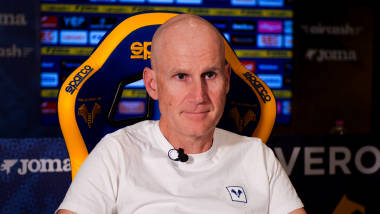
Presidio Investors President Christian Puscasiu: The Interview / VIDEO
Verona - Statements from Presidio Investors President Christian Puscasiu
The season ended with the Club’s relegation to Serie B, bringing with it all the disappointment of a fanbase and an environment that have always had a special bond with Hellas Verona. What is the first message the ownership wishes to express after this profound disappointment? "First of all, I want to thank the fans and the city of Verona. We are equally disappointed with the results of this season. Ultimately, as ownership, we are responsible for those results. We believed we had built a team capable of being competitive in Serie A. The reality of the season proved different, and we must learn from what happened in order to move forward together and rebuild Hellas Verona, bringing it back to the level that this city and its supporters deserve".
From the perspective of results, performances and the overall sporting project, have you identified what did not work? "The results speak for themselves: when a season ends this way, it means that several factors did not go according to plan. Within the budget available for the season, we decided to invest in a team we believed could compete to remain in Serie A. We were convinced that the players made available were capable of achieving that objective, but we also made a deliberate choice: to prioritize the quality of the core group of the squad over the overall depth of the roster.
This meant that injuries - and there were many, including to key players such as Serdar, Suslov, Belghali, Bella-Kotchap and others - affected the team and the results more than we had hoped. We chose the quality of the starting eleven, or at least of the first 14 players in the squad, rather than building a larger group, perhaps made up of 22 average-level players but with greater depth.
There is no need to go back over every sporting result of the season. A combination of bad luck, errors in judgment and unfavorable incidents led to this relegation. But that is sport: one day the ball can bounce your way, the next day against you. We do not want to look for excuses: the outcome of our decisions simply was not good enough. We will learn from those choices and work to achieve better results in the future.
There were also some positive aspects from a sporting perspective. The sporting department continues to identify, acquire and develop valuable players, capable of competing at the highest levels of Italian and European football. And we continue to reinvest the profits generated by those players into new talent, as in the case of Giovane’s transfer, which allowed us to acquire Edmundsson and Bowie. We will continue to rely on our sporting department in the future".
Is there a willingness on the part of the ownership to build a team capable of aiming for an immediate return to Serie A as early as next season? "The immediate priority is clear: we will approach Serie B with one single objective to return to Serie A as soon as possible, already next season. We have the resources to pursue this objective seriously. I hope that, together with the sporting department, we will be able to build one of the strongest teams in the league.
I genuinely believe that a season in which Hellas Verona fights for promotion at the Bentegodi - with fans who want nothing more than to see this Club return to where it belongs - can become something special. That energy is a resource. And we will use it".
In recent months, there have been many rumors about the Club’s financial situation. Can you clarify once and for all what the current situation is? "From a financial standpoint, debt has been significantly reduced. The tax and contractual obligations inherited from the previous ownership - and there were real obligations - have been identified, managed and partly resolved. There are no longer any unproductive salary commitments to players who are no longer part of the Club.
We are fully compliant from both a regulatory and financial standpoint. I say this clearly because, in Italian football, it is not something that can be taken for granted. The Club rests on solid economic foundations, and every euro of capital gain is reinvested to improve the Club, both from a sporting and operational perspective.
Another issue that has often been raised concerns costs related to agents and commissions. It is important to clarify that these dynamics are a structural part of the modern football system, especially in international markets and multi-layered transactions. In many cases, these are complex agreements, linked to inherited transactions or contractual structures that already existed when we arrived. From our side, the approach is always to assess the overall economic value of each transaction as carefully as possible".
Executive President Italo Zanzi has repeated this several times, but in order to definitively put these rumors to rest, can you also confirm that Presidio’s objective is not to sell the Club, but to continue with a medium- to long-term project? "Our objective has not changed: we are building the foundations of a Club that should still be here fifty years from now. We have a long-term vision, and the investments we are making are structural and lasting in nature.
In the coming days, we will make an important announcement regarding the development of the new stadium. Our intention is to continue making these investments, not to sell the Club in the short term".
After Presidio’s first full season at the helm of Hellas Verona, what is Christian Puscasiu’s assessment? "We were relegated because we did not collect enough points to stay up. As already stated clearly, the table does not lie, and we are not here to claim otherwise.
What I can do is explain, with as much honesty as possible, what we believe were the causes that led to this result. Understanding them is the necessary condition for not repeating the same mistakes. And I believe that, when looking at the full picture, the situation is more complex than simply saying “the team was not strong enough.” There were specific causes that, combined together, we believe were extraordinary rather than structural.
There is also a very concrete statistic that should not be read as an excuse, but that clearly reflects the fine margins by which this relegation was decided: we lost more than ten points by conceding goals after the seventieth minute. We are talking about matches that were balanced or under control and that, in the final twenty minutes, took a different direction. In a league like Serie A, eleven points represent the difference between survival and relegation.
Added to this is a deeper element of analysis: if you look at the performances delivered on the pitch throughout the season, there is a significant gap between the points the team would have deserved and the points it actually obtained.
This does not change the final result - which we accept - but it helps explain its nature. We are not talking about a structurally non-competitive team, but about a season in which several factors, including statistical ones, combined unfavorably.
This is not an excuse, but an element of analysis. It means that, in many matches, the team was competitive and up to the level required, but was unable to turn that competitiveness into results. It is an aspect we will have to work on with great attention, because it concerns effectiveness, management of key moments and the overall maturity of the group.
The relegation hurts. It was not what we wanted. But I can say with absolute certainty that today the Club is structurally stronger than it was when we arrived. The foundations we have built do not disappear with relegation. And it is precisely this foundation - managerial depth and infrastructure investment - that gives us every reason to believe this is a temporary setback, not the beginning of a decline.
But beyond the sporting analysis, I believe it is also right to add a direct message to those who work every day for this Club and to those who support it institutionally and commercially. To our employees, collaborators, sponsors, financial partners and our fans, I want to say clearly that we understand the disappointment this result brings, and that we fully recognize their commitment and contribution.
This is not a formal message, but a concrete acknowledgment: without the daily work of these people and without the trust of those who support the Club, none of what we are building would be possible. They deserve to know that the responsibility for this result is ours, as ownership and as sporting leadership".
Is it correct to say that all capital-gain transactions the Club has carried out and will continue to carry out are necessary to ensure financial self-sustainability and preserve long-term stability? "Yes, it is correct to say that all outgoing transactions - such as those involving Coppola, Tchatchoua, Cisse, Ghilardi and Giovane, which generated significant capital gains this season - are necessary to ensure the Club’s self-sustainability and secure a stronger position for the future. Every euro generated by these transactions - net of commissions and obligations owed to previous clubs - has been reinvested in the Club: in the squad, in the infrastructure and in the future.
I want to be very clear on this point, because I believe it is important for the fans: this ownership does not extract value from the Club. The model based on transfer-market transactions exists to finance the Club’s growth, not to distribute capital to shareholders. The ownership is committed to reinvesting 100% of what it receives.
At the same time, I believe it is essential to explain why this model is necessary. Sustainability is not a renunciation of ambition, but the condition that allows a Club to remain competitive over time without putting its own stability at risk. We want to build a Hellas Verona that can grow, compete and endure, not one that achieves short-term results only to pay the price in the years that follow".
Are you fully aware of the economic gap between Serie B and Serie A, and how do you intend to address it? "Yes, of course, we are aware of it. We know very well the difference between Serie A and Serie B. The objective is to build a competitive team on the pitch while, at the same time, maintaining great focus on the Club’s economic and financial stability".
In light of this situation, and considering Presidio’s efforts for the good of the Club, how important will it be to build a squad capable of aiming for an immediate return to Serie A as early as next season? "The immediate priority is clear: we will approach Serie B with one single objective — to return to Serie A already next season. We have the resources to pursue this objective seriously. I hope that, together with the sporting department, we will be able to build one of the strongest teams in the league.
I genuinely believe that a season in which Hellas Verona fights for promotion at the Bentegodi — with fans who want nothing more than to see this Club return to where it belongs — can become something special. That energy is a resource. And we will use it.
We are building the right foundations. We will not repeat the mistakes that contributed to this season. And we will move forward with these objectives: toward Serie A, toward a new stadium, toward a Hellas Verona truly built to last over time.
Our vision is clear and long-term. All the decisions we are taking — from infrastructure investments to squad building — are aimed at strengthening the Club in a stable and lasting way. We are not working with a short-term horizon, but on a project that has continuity and ambition over the years".
More specifically, in order to achieve promotion, is your idea to keep a core group of players from this season or to carry out a new technical revolution? "It is very difficult to answer this question. When defining the composition of a team, there are many factors to consider: the player’s willingness to stay, the type of offer that may arrive from another club for us and, above all, for the player, as well as the normal dynamics of the transfer market, which you all know very well".
Without naming names, could one of the priorities be to identify the new coach as soon as possible, in order to better plan for the future? "Without naming any names, I can confirm that this is currently our number one priority".
Since your arrival, you have shown a strong willingness to listen to the feelings of the fans. How do you intend to win them back after such a negative and frustrating season? "By being honest, as I have tried to be today, and then by following that with action. The analysis has been done. We have learned from our mistakes. The work begins again now: building the team for Serie B with the specific objective of returning to Serie A in a single season, with greater clarity and stronger foundations than twelve months ago. That is where all our attention is focused. Analyzing the past is necessary. Remaining stuck in it is not".
Stadium issue: in November, the expression of interest was submitted to the Municipality. Can you explain the ownership’s vision regarding the construction of a new stadium? "The Bentegodi was built in 1963. It is one of the largest stadiums in Italy, but it has real structural limitations and is owned by the Municipality of Verona. This means that we are renting our own home, with limited control over an asset that is fundamental both for the commercial experience and for the fan experience. This is not a sustainable situation for a Club with long-term ambitions.
We have made a serious commitment to changing this situation. We completed a rigorous economic and market feasibility study, assessed every realistic development scenario and concluded that the best path is a new stadium on the current Bentegodi site: preserving the place that the fans know, while at the same time creating the modern infrastructure the Club needs.
We carried out a competitive process to select the architect and, in the coming hours, we will publish an important announcement in this regard.
What a new stadium would mean is extremely significant: a substantial increase in matchday and event revenues, income streams independent of the division in which we play, and a permanently stronger financial base for the Club. It would reduce our dependence on the player market to finance operations. It would allow us to invest with greater continuity in the team. And it would give the fans an experience worthy of the pride they feel for this Club.
But I want to be clear on one point: a project of this scale cannot be delivered through private will alone. It requires political alignment at local, regional and potentially national level. It requires the Municipality of Verona to be a true partner, and we are building that relationship actively and in good faith. It will likely require a combination of private investment and public support in order for the project to become reality. None of this is unusual for major stadium development projects in Italy or in Europe: many of the most important venues of the last decade have been delivered through public-private partnerships. But it also means that the timing is not entirely in our hands".
Rumors have circulated in the city about a possible interest in the Payanini Center which, according to some reports, could cease its current activities at the end of June. Is there any truth to this, or do you believe the Peschiera training center is fully adequate for the needs of the First Team and Primavera? "No, there is no truth to the rumors regarding that training center. The Peschiera training facility has been significantly improved since our arrival. We have invested in the First Team environment, the Primavera, the women’s team and the youth-sector infrastructure that supports some of these areas, and we believe these facilities are more than adequate.
Given the high number of teams we have in the boys’ and girls’ Youth Sectors, our intention is to continue improving the training areas and facilities.
We are actively working toward owning our own training center rather than using a rented one: a transition that would turn an annual operating cost into a permanent Club asset, give us full autonomy over the development environment and allow us to build a centralized academy capable of attracting talent from across the region and beyond".
Many fans have wondered why one of your first structural decisions was to sell Bottagisio, which had been acquired by the previous ownership and intended to centralize all youth-sector activities. Can you explain the reason for this choice? "The answer is simple: we believed that the structural characteristics of that training center were not suitable for our needs and requirements".
Hellas Verona is not only the First Team. According to many, these have been two positive seasons for the men’s Youth Sector, which has always been a valuable source of talent. How do you intend to continue developing this area? "The Primavera and the Youth Sector are not simply pipelines for the First Team. They are engines that produce technical and economic value. Coppola, who moved to Brighton this summer for a significant fee, came through our academy. Cissè — who signed with Milan at the beginning of this year — joined our youth sector at the age of fourteen, scored sixteen goals in a single Primavera season, made his Serie A debut with us, went on loan to Catanzaro in Serie B and was sold at nineteen to one of the biggest clubs in Italy. Today, he is also an Under-21 international.
This is the full picture of what a well-run Youth Sector can produce. We identified him, developed him and, when the market recognized his value, realized that value at the right time. All of this is made possible by the excellent work of our Head of Youth Sector, Massimo Margiotta, and by the large and highly competent working group that contributes every day to the growth of our young players.
The Primavera and the academy produce players who go on to represent Italy at youth level. This connection with young local talent is important to us for reasons that go beyond the economic value it may generate in the future".
This season also saw the growth of the Club’s women’s sector, with many new registered players and the First Team maintaining its division status. Are these solid foundations to continue developing Hellas Verona Women? "This season was positive in many respects. We increased the visibility of women’s football through initiatives such as the Double Header, launching a format that opened men’s professional football stadiums to other Serie B clubs as well, such as Como 1907, Frosinone and Cesena.
From the Youth-Sector perspective, we achieved important results, including retaining top-flight status with the Primavera team and reaching the national playoffs with the Under 17s, alongside the continued growth of the younger age categories. The First Team also maintained its division status, creating a solid foundation on which to build next season from both a commercial and communications perspective.
At the same time, we are working on several international programs to further raise our sporting level and expand the brand abroad, also building on experiences such as our summer tour in Germany.
Overall, these are solid foundations that give us confidence and momentum to continue developing Hellas Verona Women in the coming seasons".
A few days ago, the Hellas Verona Foundation’s charity event brought together nearly 400 people in support of its initiatives. In your view, what are the Foundation’s main values and mission? "Connecting the Club to the Verona community. I will let the work speak for itself.
We funded the construction of a residential facility so that the families of children undergoing transplant treatment in the Pediatric Oncohematology department can have accommodation close to their children. We donate surplus meals after every home match. We have carried out educational programs on inclusion and fair play in more than 130 schools across the province. Visually impaired fans can follow every home match thanks to audio description. The collaboration launched with the Ape’n Down cooperative involves young people with intellectual disabilities in hospitality activities: not as a symbolic gesture, but as members of the staff. Our flagship project this season, ‘Casa Insieme a Voi’ together with Caritas Verona, is a co-housing facility for young women facing housing difficulties, including victims of violence.
With great pride and satisfaction, we support an initiative that is particularly meaningful to us: Hellas Verona 4 Special, a team of girls and boys with intellectual disabilities who, thanks to our coaches, can experience football in a fun and educational way.
I find all of this work deeply meaningful. It is one of the aspects of this Club that I am most proud to be part of. A Hellas Verona that will still be here fifty years from now is a Club that will have earned its place in this city: not only in the league table, but in the community. The Hellas Verona Foundation best represents the way we work every day to achieve that objective".